

How To Get Gold Skins In Aba

The human skull is used universally as a symbol of expiry.
Death is the irreversible abeyance of all biological functions that sustain an organism.[1] For organisms with a brain, death tin too be defined as the irreversible cessation of functioning of the whole brain, including brainstem, and[2] [3] encephalon decease is sometimes used every bit a legal definition of decease.[four] The remains of a former organism commonly brainstorm to decompose shortly subsequently expiry. Death is an inevitable procedure that eventually occurs in nearly all organisms.
Expiry is generally practical to whole organisms; the similar process seen in individual components of an organism, such as cells or tissues, is necrosis. Something that is non considered an organism, such as a virus, tin can exist physically destroyed simply is not said to die. Equally of the early 21st century, over 150,000 humans die each mean solar day, with ageing being by far the about common cause of death.[ citation needed ]
Many cultures and religions have the idea of an afterlife, and also may hold the thought of judgement of good and bad deeds in i's life (heaven, hell, karma).
Diagnosis
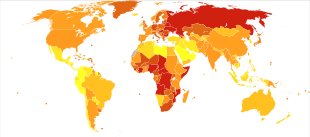
World Health Organization estimated number of deaths per million persons in 2012
i,054–4,598
iv,599–v,516
v,517–6,289
vi,290–6,835
6,836–7,916
7,917–8,728
eight,729–9,404
9,405–10,433
x,434–12,233
12,234–17,141
Issues of definition
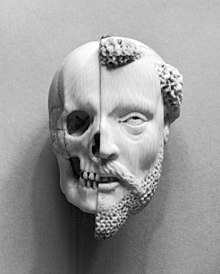
French – 16th-/17th-century ivory pendant, Monk and Death, recalling mortality and the certainty of death (Walters Art Museum)
The concept of expiry is a key to human understanding of the phenomenon.[five] There are many scientific approaches and diverse interpretations of the concept. Additionally, the advent of life-sustaining therapy and the numerous criteria for defining death from both a medical and legal standpoint, have fabricated it hard to create a single unifying definition.
One of the challenges in defining decease is in distinguishing it from life. As a point in time, death would seem to refer to the moment at which life ends. Determining when decease has occurred is difficult, as cessation of life functions is often not simultaneous across organ systems.[6] Such determination, therefore, requires drawing precise conceptual boundaries between life and expiry. This is difficult, due to there being little consensus on how to define life.
Information technology is possible to define life in terms of consciousness. When consciousness ceases, an organism can exist said to accept died. One of the flaws in this approach is that there are many organisms that are alive only probably non conscious (for example, single-celled organisms). Some other trouble is in defining consciousness, which has many different definitions given by modern scientists, psychologists and philosophers. Additionally, many religious traditions, including Abrahamic and Dharmic traditions, hold that death does not (or may non) entail the end of consciousness. In certain cultures, expiry is more than of a process than a single event. It implies a slow shift from one spiritual state to some other.[7]
Other definitions for death focus on the character of cessation of organismic functioning and a human expiry which refers to irreversible loss of personhood. More specifically, death occurs when a living entity experiences irreversible cessation of all functioning.[viii] As information technology pertains to human life, decease is an irreversible procedure where someone loses their being every bit a person.[8]

Historically, attempts to define the exact moment of a human's death have been subjective, or imprecise. Death was once defined as the cessation of heartbeat (cardiac abort) and of animate, merely the development of CPR and prompt defibrillation have rendered that definition inadequate because breathing and heartbeat can sometimes be restarted. This type of expiry where circulatory and respiratory arrest happens is known equally the circulatory definition of death (DCDD). Proponents of the DCDD believe that this definition is reasonable because a person with permanent loss of circulatory and respiratory function should be considered dead.[nine] Critics of this definition land that while abeyance of these functions may be permanent, it does not mean the state of affairs is irreversible, because if CPR was applied, the person could be revived.[9] Thus, the arguments for and against the DCDD boil down to a matter of defining the actual words "permanent" and "irreversible," which further complicates the challenge of defining decease. Furthermore, events which were causally linked to death in the past no longer kill in all circumstances; without a functioning heart or lungs, life can sometimes be sustained with a combination of life support devices, organ transplants and artificial pacemakers.
Today, where a definition of the moment of death is required, doctors and coroners usually plough to "brain expiry" or "biological death" to define a person equally existence dead; people are considered dead when the electric activity in their encephalon ceases. It is presumed that an cease of electrical activity indicates the end of consciousness. Intermission of consciousness must be permanent, and not transient, equally occurs during certain sleep stages, and specially a coma. In the example of sleep, EEGs can easily tell the difference.
The category of "brain death" is seen every bit problematic by some scholars. For instance, Dr. Franklin Miller, senior faculty member at the Department of Bioethics, National Institutes of Health, notes: "By the tardily 1990s... the equation of brain decease with death of the human existence was increasingly challenged by scholars, based on evidence regarding the array of biological functioning displayed past patients correctly diagnosed as having this condition who were maintained on mechanical ventilation for substantial periods of time. These patients maintained the ability to sustain circulation and respiration, command temperature, excrete wastes, heal wounds, fight infections and, about dramatically, to gestate fetuses (in the case of pregnant "brain-expressionless" women)."[10]
While "encephalon expiry" is viewed as problematic by some scholars, there are certainly proponents of information technology that believe this definition of expiry is the most reasonable for distinguishing life from expiry. The reasoning behind the support for this definition is that brain death has a gear up of criteria that is reliable and reproducible.[eleven] Also, the encephalon is crucial in determining our identity or who we are as human beings. The stardom should be fabricated that "brain death" cannot be equated with one who is in a vegetative state or coma, in that the former situation describes a state that is beyond recovery.[11]
Those people maintaining that just the neo-cortex of the brain is necessary for consciousness sometimes debate that only electrical activity should be considered when defining expiry. Eventually it is possible that the benchmark for decease will exist the permanent and irreversible loss of cerebral part, as evidenced past the expiry of the cerebral cortex. All hope of recovering human thought and personality is then gone given electric current and foreseeable medical technology. At present, in most places the more bourgeois definition of death – irreversible abeyance of electrical activeness in the whole brain, as opposed to just in the neo-cortex – has been adopted (for example the Compatible Determination Of Death Human activity in the Usa). In 2005, the Terri Schiavo case brought the question of brain decease and bogus sustenance to the front of American politics.
Even by whole-brain criteria, the decision of brain death can be complicated. EEGs can detect spurious electrical impulses, while certain drugs, hypoglycemia, hypoxia, or hypothermia can suppress or even stop brain activity on a temporary basis. Because of this, hospitals accept protocols for determining brain death involving EEGs at widely separated intervals under defined conditions.
In the by, adoption of this whole-brain definition was a conclusion of the President's Commission for the Study of Upstanding Problems in Medicine and Biomedical and Behavioral Research in 1980.[12] They concluded that this arroyo to defining death sufficed in reaching a uniform definition nationwide. A multitude of reasons were presented to support this definition including: uniformity of standards in law for establishing expiry; consumption of a family's fiscal resource for artificial life back up; and legal establishment for equating encephalon expiry with death in order to proceed with organ donation.[13]

Timeline of postmortem changes (stages of decease).
Aside from the event of support of or dispute against brain death, at that place is another inherent problem in this categorical definition: the variability of its awarding in medical do. In 1995, the American Academy of Neurology (AAN), established a set of criteria that became the medical standard for diagnosing neurologic death. At that time, three clinical features had to exist satisfied in lodge to decide "irreversible cessation" of the total brain including: coma with clear etiology, abeyance of animate, and lack of brainstem reflexes.[14] This fix of criteria was and then updated once more most recently in 2010, just substantial discrepancies notwithstanding remain across hospitals and medical specialties.[xiv]
The problem of defining decease is especially imperative as it pertains to the dead donor dominion, which could be understood equally one of the following interpretations of the dominion: there must be an official declaration of decease in a person before starting organ procurement or that organ procurement cannot outcome in death of the donor.[nine] A great deal of controversy has surrounded the definition of death and the dead donor dominion. Advocates of the rule believe the rule is legitimate in protecting organ donors while likewise countering confronting any moral or legal objection to organ procurement. Critics, on the other hand, believe that the dominion does not uphold the all-time interests of the donors and that the rule does not effectively promote organ donation.[9]
Signs
Signs of decease or stiff indications that a warm-blooded fauna is no longer alive are:
- Respiratory arrest (no breathing)
- Cardiac arrest (no pulse)
- Brain decease (no neuronal activity)
The stages that follow later on decease are:
- Pallor mortis , paleness which happens in fifteen–120 minutes afterwards death
- Algor mortis , the reduction in torso temperature following decease. This is generally a steady refuse until matching ambient temperature
- Rigor mortis , the limbs of the corpse become stiff (Latin rigor) and difficult to motion or manipulate
- Livor mortis , a settling of the blood in the lower (dependent) portion of the body
- Putrefaction, the beginning signs of decomposition
- Decomposition, the reduction into simpler forms of matter, accompanied past a strong, unpleasant odour.
- Skeletonization, the end of decomposition, where all soft tissues take decomposed, leaving only the skeleton.
- Fossilization, the natural preservation of the skeletal remains formed over a very long period
Legal
The death of a person has legal consequences that may vary betwixt different jurisdictions. A death certificate is issued in well-nigh jurisdictions, either by a physician, or by an authoritative office upon presentation of a md's announcement of death.
Misdiagnosed
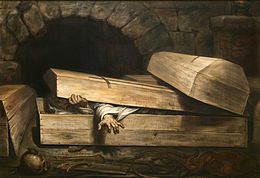
The Premature Burying, Antoine Wiertz's painting of a man buried alive, 1854
There are many anecdotal references to people being alleged expressionless by physicians and then "coming dorsum to life", sometimes days later in their own coffin, or when embalming procedures are virtually to begin. From the mid-18th century onwards, in that location was an upsurge in the public's fear of existence mistakenly buried alive,[15] and much argue about the uncertainty of the signs of death. Diverse suggestions were made to test for signs of life before burial, ranging from pouring vinegar and pepper into the corpse's oral fissure to applying red hot pokers to the feet or into the rectum.[16] Writing in 1895, the md J.C. Ouseley claimed that as many as 2,700 people were buried prematurely each year in England and Wales, although others estimated the figure to be closer to 800.[17]
In cases of electrical shock, cardiopulmonary resuscitation (CPR) for an hour or longer can permit stunned nerves to recover, assuasive an manifestly dead person to survive. People establish unconscious under icy h2o may survive if their faces are kept continuously common cold until they make it at an emergency room.[18] This "diving response", in which metabolic action and oxygen requirements are minimal, is something humans share with cetaceans chosen the mammalian diving reflex.[18]
As medical technologies accelerate, ideas about when expiry occurs may have to be re-evaluated in light of the ability to restore a person to vitality after longer periods of credible decease (as happened when CPR and defibrillation showed that cessation of heartbeat is inadequate every bit a decisive indicator of death). The lack of electrical encephalon activeness may non be enough to consider someone scientifically dead. Therefore, the concept of data-theoretic death[19] has been suggested as a improve means of defining when truthful death occurs, though the concept has few practical applications outside the field of cryonics.
There have been some scientific attempts to bring dead organisms back to life, merely with express success.[20]
Causes
The leading cause of human death in developing countries is communicable diseases. The leading causes in developed countries are atherosclerosis (heart illness and stroke), cancer, and other diseases related to obesity and aging. By an extremely wide margin, the largest unifying crusade of expiry in the adult world is biological aging,[21] leading to diverse complications known as crumbling-associated diseases. These conditions crusade loss of homeostasis, leading to cardiac abort, causing loss of oxygen and food supply, causing irreversible deterioration of the brain and other tissues. Of the roughly 150,000 people who die each day across the globe, near two thirds die of age-related causes.[21] In industrialized nations, the proportion is much college, approaching 90%.[21] With improved medical capability, dying has become a condition to be managed. Dwelling house deaths, in one case commonplace, are at present rare in the developed world.

American children smoking in 1910. Tobacco smoking caused an estimated 100 one thousand thousand deaths in the 20th century.[22]
In developing nations, inferior sanitary conditions and lack of access to modern medical applied science makes expiry from infectious diseases more than mutual than in developed countries. One such disease is tuberculosis, a bacterial disease which killed 1.8M people in 2015.[23] Malaria causes about 400–900M cases of fever and 1–3M deaths annually.[24] AIDS death price in Africa may reach 90–100M by 2025.[25] [26]
According to Jean Ziegler (United nations Special Reporter on the Right to Nutrient, 2000 – Mar 2008), mortality due to malnutrition accounted for 58% of the total mortality charge per unit in 2006. Ziegler says worldwide approximately 62M people died from all causes and of those deaths more than 36M died of hunger or diseases due to deficiencies in micronutrients.[27]
Tobacco smoking killed 100 million people worldwide in the 20th century and could kill one billion people around the world in the 21st century, a Globe Health Arrangement written report warned.[22]
Many leading adult world causes of decease can exist postponed by diet and concrete activeness, but the accelerating incidence of disease with historic period however imposes limits on human longevity. The evolutionary crusade of crumbling is, at all-time, only just starting time to exist understood. Information technology has been suggested that direct intervention in the aging procedure may at present exist the most effective intervention against major causes of death.[28]

Le Suicidé past Édouard Manet depicts a human who has recently committed suicide via a firearm
Selye proposed a unified not-specific approach to many causes of death. He demonstrated that stress decreases adjustability of an organism and proposed to describe the adaptability as a special resource, adaptation energy. The fauna dies when this resource is exhausted.[29] Selye assumed that the adaptability is a finite supply, presented at birth. Later on, Goldstone proposed the concept of a production or income of adaptation free energy which may be stored (up to a limit), as a majuscule reserve of accommodation.[xxx] In recent works, adaptation energy is considered as an internal coordinate on the "dominant path" in the model of adaptation. It is demonstrated that oscillations of well-being appear when the reserve of adaptability is about exhausted.[31]
In 2012, suicide overtook auto crashes for leading causes of human being injury deaths in the U.Southward., followed by poisoning, falls, and murder.[32] Causes of death are unlike in dissimilar parts of the world. In high-income and middle income countries nearly half upward to more than two thirds of all people live beyond the age of seventy and predominantly dice of chronic diseases. In low-income countries, where less than one in five of all people accomplish the age of lxx, and more than a third of all deaths are among children under xv, people predominantly dice of infectious diseases.[33]
Dissection
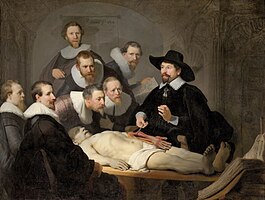
An dissection, also known as a postmortem exam or an obduction, is a medical process that consists of a thorough test of a homo corpse to determine the cause and fashion of a person's death and to evaluate whatsoever disease or injury that may be present. It is ordinarily performed by a specialized medical doctor called a pathologist.
Autopsies are either performed for legal or medical purposes. A forensic autopsy is carried out when the cause of decease may be a criminal matter, while a clinical or academic autopsy is performed to find the medical cause of death and is used in cases of unknown or uncertain death, or for research purposes. Autopsies can be farther classified into cases where external examination suffices, and those where the body is dissected and an internal examination is conducted. Permission from next of kin may be required for internal autopsy in some cases. Once an internal dissection is complete the torso is generally reconstituted past sewing information technology back together. Dissection is important in a medical environment and may shed light on mistakes and help amend practices.
A necropsy, which is not e'er a medical procedure, was a term previously used to describe an unregulated postmortem exam. In modern times, this term is more than unremarkably associated with the corpses of animals.
Senescence

Senescence refers to a scenario when a living beingness is able to survive all calamities, just eventually dies due to causes relating to one-time historic period. Animal and constitute cells commonly reproduce and function during the whole period of natural existence, but the aging process derives from deterioration of cellular action and ruination of regular functioning. Aptitude of cells for gradual deterioration and mortality means that cells are naturally sentenced to stable and long-term loss of living capacities, even despite continuing metabolic reactions and viability. In the Great britain, for example, 9 out of ten of all the deaths that occur on a daily basis relates to senescence, while around the world information technology accounts for two-thirds of 150,000 deaths that accept place daily.[34] [ full citation needed ]
Almost all animals who survive external hazards to their biological functioning eventually die from biological crumbling, known in life sciences as "senescence". Some organisms experience negligible senescence, even exhibiting biological immortality. These include the jellyfish Turritopsis dohrnii,[35] the hydra, and the planarian. Unnatural causes of decease include suicide and predation. From all causes, roughly 150,000 people die effectually the world each day.[21] Of these, two thirds die straight or indirectly due to senescence, but in industrialized countries – such as the U.s.a., the United Kingdom, and Federal republic of germany – the rate approaches ninety% (i.east., about ix out of 10 of all deaths are related to senescence).[21]
Physiological death is now seen as a procedure, more than than an consequence: conditions once considered indicative of expiry are now reversible.[36] Where in the process a dividing line is fatigued between life and decease depends on factors beyond the presence or absence of vital signs. In general, clinical decease is neither necessary nor sufficient for a determination of legal expiry. A patient with working center and lungs adamant to be brain expressionless can be pronounced legally dead without clinical expiry occurring.
Cryonics

Technicians prepare a trunk for cryopreservation in 1985.
Cryonics (from Greek κρύος 'kryos-' meaning 'icy cold') is the low-temperature preservation of animals and humans who cannot be sustained by contemporary medicine, with the hope that healing and resuscitation may be possible in the future.[37] [38]
Cryopreservation of people or large animals is not reversible with electric current engineering science. The stated rationale for cryonics is that people who are considered dead by current legal or medical definitions may not necessarily be expressionless according to the more stringent information-theoretic definition of death.[19] [39]
Some scientific literature is claimed to support the feasibility of cryonics.[twoscore] Medical science and cryobiologists generally regards cryonics with skepticism.[41]
Life extension
Life extension refers to an increase in maximum or average lifespan, especially in humans, by slowing down or reversing the processes of aging through anti-aging measures. Despite the fact that aging is by far the most mutual cause of expiry worldwide, it is socially mostly ignored every bit such and seen as "necessary" and "inevitable" anyway, which is why piddling money is spent on enquiry into anti-crumbling therapies, a phenomenon known every bit the pro-aging trance.[21]
Boilerplate lifespan is determined by vulnerability to accidents and age or lifestyle-related afflictions such as cancer, or cardiovascular affliction. Extension of boilerplate lifespan can exist achieved by good diet, practise and avoidance of hazards such as smoking. Maximum lifespan is also determined by the rate of aging for a species inherent in its genes. Currently, the only widely recognized method of extending maximum lifespan is calorie restriction. Theoretically, extension of maximum lifespan can exist achieved by reducing the rate of aging impairment, by periodic replacement of damaged tissues, or by molecular repair or rejuvenation of deteriorated cells and tissues.
A Us poll establish that religious people and irreligious people, likewise as men and women and people of unlike economic classes accept similar rates of support for life extension, while Africans and Hispanics accept college rates of support than white people.[42] 38 percent of the polled said they would desire to have their aging process cured.
Researchers of life extension are a subclass of biogerontologists known as "biomedical gerontologists". They effort to understand the nature of aging and they develop treatments to reverse aging processes or to at least slow them downwardly, for the comeback of health and the maintenance of youthful vigor at every stage of life. Those who take reward of life extension findings and seek to employ them upon themselves are called "life extensionists" or "longevists". The primary life extension strategy currently is to apply available anti-aging methods in the hope of living long enough to benefit from a complete cure to aging one time it is adult.
Location

Before nigh 1930, most people in Western countries died in their own homes, surrounded by family, and comforted by clergy, neighbors, and doctors making firm calls.[45] By the mid-20th century, half of all Americans died in a hospital.[46] By the start of the 21st century, only nearly twenty–25% of people in developed countries died outside of a medical institution.[46] [47] [48] The shift away from dying at abode towards dying in a professional person medical environment has been termed the "Invisible Death".[46] This shift occurred gradually over the years, until virtually deaths now occur exterior the home.[49]
Psychology
Death studies is a field inside psychology.[50] Many people are afraid of dying. Discussing, thinking about, or planning for their ain deaths causes them discomfort. This fearfulness may cause them to put off fiscal planning, preparing a will and testament, or requesting assistance from a hospice organization.
Different people take different responses to the idea of their own deaths. Philosopher Galen Strawson writes that the death that many people wish for is an instant, painless, unexperienced anything.[51] In this unlikely scenario, the person dies without realizing it and without being able to fear it. Ane moment the person is walking, eating, or sleeping, and the adjacent moment, the person is dead. Strawson reasons that this type of expiry would not take anything away from the person, as he believes that a person cannot have a legitimate claim to ownership in the time to come.[51] [52]
Club and culture

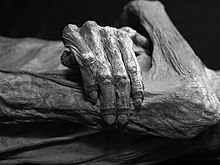
In club, the nature of death and humanity'south sensation of its ain mortality has for millennia been a business of the world'due south religious traditions and of philosophical inquiry. This includes belief in resurrection or an afterlife (associated with Abrahamic religions), reincarnation or rebirth (associated with Dharmic religions), or that consciousness permanently ceases to be, known as eternal oblivion (associated with Secular humanism).[53]
Celebration ceremonies after decease may include diverse mourning, funeral practices and ceremonies of honouring the deceased. The physical remains of a person, unremarkably known as a corpse or body, are usually interred whole or cremated, though amid the world's cultures there are a multifariousness of other methods of mortuary disposal. In the English linguistic communication, blessings directed towards a expressionless person include rest in peace (originally the Latin requiescat in footstep), or its initialism RIP.
Death is the center of many traditions and organizations; community relating to expiry are a feature of every civilization around the world. Much of this revolves around the care of the dead, too as the afterlife and the disposal of bodies upon the onset of death. The disposal of homo corpses does, in general, begin with the last offices before significant fourth dimension has passed, and ritualistic ceremonies oftentimes occur, almost ordinarily interment or cremation. This is non a unified practice; in Tibet, for instance, the body is given a sky burial and left on a mountain acme. Proper preparation for expiry and techniques and ceremonies for producing the ability to transfer one's spiritual attainments into another torso (reincarnation) are subjects of detailed study in Tibet.[54] Mummification or embalming is too prevalent in some cultures, to retard the rate of disuse.
Legal aspects of death are also part of many cultures, particularly the settlement of the deceased estate and the bug of inheritance and in some countries, inheritance taxation.
Death sentence is also a culturally divisive aspect of expiry. In well-nigh jurisdictions where death sentence is carried out today, the death penalty is reserved for premeditated murder, espionage, treason, or every bit part of war machine justice. In some countries, sexual crimes, such every bit adultery and sodomy, carry the death penalty, as do religious crimes such as betrayment, the formal renunciation of one's religion. In many retentionist countries, drug trafficking is besides a uppercase offense. In People's republic of china, human trafficking and serious cases of corruption are also punished past the death penalty. In militaries around the world courts-martial have imposed expiry sentences for offenses such equally cowardice, desertion, insubordination, and wildcat.[55]
Decease in warfare and in suicide assail also have cultural links, and the ideas of dulce et decorum est pro patria mori, mutiny punishable by death, grieving relatives of dead soldiers and decease notification are embedded in many cultures. Recently in the western world, with the increment in terrorism post-obit the September 11 attacks, but also further back in time with suicide bombings, kamikaze missions in Earth War 2 and suicide missions in a host of other conflicts in history, expiry for a cause by mode of suicide set on, and martyrdom have had significant cultural impacts.
Suicide in general, and peculiarly euthanasia, are as well points of cultural debate. Both acts are understood very differently in different cultures. In Japan, for example, ending a life with honor by seppuku was considered a desirable decease, whereas according to traditional Christian and Islamic cultures, suicide is viewed as a sin. Death is personified in many cultures, with such symbolic representations as the Grim Reaper, Azrael, the Hindu god Yama and Father Time.

Santa Muerte, the personification of death in Mexican tradition[56]
In Brazil, a human decease is counted officially when it is registered past existing family unit members at a cartório, a government-authorized registry. Before being able to file for an official death, the deceased must have been registered for an official nascency at the cartório. Though a Public Registry Law guarantees all Brazilian citizens the right to annals deaths, regardless of their financial means, of their family unit members (often children), the Brazilian government has not taken away the brunt, the subconscious costs and fees, of filing for a decease. For many impoverished families, the indirect costs and burden of filing for a death lead to a more appealing, unofficial, local, cultural burial, which in turn raises the debate virtually inaccurate mortality rates.[57]
Talking about death and witnessing information technology is a difficult event with near cultures. Western societies may similar to treat the expressionless with the utmost material respect, with an official embalmer and associated rites. Eastern societies (like India) may exist more open to accepting it as a fait accompli, with a funeral procession of the dead body ending in an open-air burning-to-ashes of the same.
Consciousness
Much involvement and debate surroundings the question of what happens to 1's consciousness equally one's torso dies. The belief in the permanent loss of consciousness later death is often chosen eternal oblivion. Belief that the stream of consciousness is preserved after physical death is described past the term afterlife. Neither are likely to ever be confirmed without the ponderer having to really die.
In biology

Afterward decease, the remains of a former organism become part of the biogeochemical bicycle, during which animals may exist consumed by a predator or a scavenger.[58] Organic material may so be further decomposed by detritivores, organisms which recycle detritus, returning it to the surround for reuse in the food chain, where these chemicals may somewhen end upwardly beingness consumed and assimilated into the cells of an organism. Examples of detritivores include earthworms, woodlice and dung beetles.
Microorganisms besides play a vital part, raising the temperature of the decomposing matter equally they break it downward into withal simpler molecules. Not all materials demand to exist fully decomposed. Coal, a fossil fuel formed over vast tracts of fourth dimension in swamp ecosystems, is ane instance.
Natural selection
Contemporary evolutionary theory sees death as an important function of the process of natural pick.[59] Information technology is considered that organisms less adjusted to their environment are more than likely to dice having produced fewer offspring, thereby reducing their contribution to the genetic pool. Their genes are thus somewhen bred out of a population, leading at worst to extinction and, more positively, making the process possible, referred to every bit speciation. Frequency of reproduction plays an equally important part in determining species survival: an organism that dies young but leaves numerous offspring displays, according to Darwinian criteria, much greater fitness than a long-lived organism leaving just one.
Extinction

A dodo, the bird that became a byword in the English language language for the extinction of a species[60]
Extinction is the cessation of existence of a species or group of taxa, reducing biodiversity. The moment of extinction is generally considered to be the death of the last private of that species (although the chapters to breed and recover may have been lost earlier this point). Considering a species' potential range may exist very big, determining this moment is difficult, and is usually washed retrospectively. This difficulty leads to phenomena such every bit Lazarus taxa, where species presumed extinct abruptly "reappear" (typically in the fossil record) subsequently a period of apparent absence. New species arise through the procedure of speciation, an aspect of evolution. New varieties of organisms ascend and thrive when they are able to find and exploit an ecological niche – and species become extinct when they are no longer able to survive in changing atmospheric condition or confronting superior competition.
Evolution of aging and mortality
Inquiry into the development of aging aims to explain why so many living things and the vast bulk of animals weaken and die with age (exceptions include Hydra and the jellyfish Turritopsis dohrnii, which enquiry shows to be biologically immortal). The evolutionary origin of senescence remains one of the fundamental puzzles of biology. Gerontology specializes in the scientific discipline of human aging processes.
Organisms showing simply asexual reproduction (e.chiliad. bacteria, some protists, like the euglenoids and many amoebozoans) and unicellular organisms with sexual reproduction (colonial or not, similar the volvocine algae Pandorina and Chlamydomonas) are "immortal" at some extent, dying only due to external hazards, like being eaten or coming together with a fatal accident. In multicellular organisms (and also in multinucleate ciliates),[61] with a Weismannist development, that is, with a division of labor between mortal somatic (body) cells and "immortal" germ (reproductive) cells, expiry becomes an essential office of life, at least for the somatic line.[62]
The Volvox algae are among the simplest organisms to exhibit that division of labor betwixt two completely unlike prison cell types, and as a upshot include expiry of somatic line as a regular, genetically regulated part of its life history.[62] [63]
Religious views
Buddhism
In Buddhist doctrine and practice, death plays an important office. Awareness of expiry was what motivated Prince Siddhartha to strive to discover the "deathless" and finally to achieve enlightenment. In Buddhist doctrine, death functions as a reminder of the value of having been born every bit a human being. Being reborn equally a human existence is considered the only country in which ane can attain enlightenment. Therefore, death helps remind oneself that one should non take life for granted. The conventionalities in rebirth among Buddhists does not necessarily remove death feet, since all existence in the cycle of rebirth is considered filled with suffering, and being reborn many times does not necessarily mean that one progresses.[64]
Death is part of several key Buddhist tenets, such as the Four Noble Truths and dependent origination.[64]
Christianity
While at that place are different sects of Christianity with different branches of belief; the overarching credo on death grows from the knowledge of afterlife. Meaning later on death the individual will undergo a separation from mortality to immortality; their soul leaves the body entering a realm of spirits. Post-obit this separation of body and spirit (i.east. death) resurrection will occur.[65] Representing the same transformation Jesus Christ embodied after his body was placed in the tomb for three days. Like Him, each person's body volition be resurrected reuniting the spirit and body in a perfect grade.[66] This process allows the individuals soul to withstand expiry and transform into life after expiry.
Hinduism

In Hindu texts, death is described as the individual eternal spiritual jiva-atma (soul or conscious self) exiting the electric current temporary cloth body. The soul exits this torso when the body tin can no longer sustain the conscious cocky (life), which may be due to mental or physical reasons, or more than accurately, the inability to act on one'due south kama (material desires). During conception, the soul enters a compatible new body based on the remaining merits and demerits of i'south karma (good/bad material activities based on dharma) and the state of one's mind (impressions or last thoughts) at the time of death.
Usually the procedure of reincarnation (soul's transmigration) makes one forget all memories of one's previous life. Because goose egg really dies and the temporary material body is ever changing, both in this life and the next, death means forgetfulness of one's previous experiences (previous textile identity).
Material beingness is described equally existence full of miseries arising from birth, disease, old age, death, heed, weather, etc. To conquer samsara (the cycle of death and rebirth) and go eligible for i of the different types of moksha (liberation), 1 has to beginning conquer kama (textile desires) and get cocky-realized. The homo grade of life is most suitable for this spiritual journey, especially with the help of sadhu (self-realized saintly persons), sastra (revealed spiritual scriptures), and guru (self-realized spiritual masters), given all three are in agreement.
Islam
The Islamic view is that death is the separation of the soul from the body likewise every bit the commencement of the afterlife.[67] The afterlife or akhirah is one of the six primary beliefs in Islam. Rather than seeing death as the cease of life, Muslims consider decease as a continuation of life in another form.[68] In Islam, the life on earth right at present is a short, temporary life and a testing period for every soul. The true life begins with the 24-hour interval of Judgement, when all people will exist divided into two groups. The righteous believers volition be welcomed to janna (sky) and the disbelievers and evildoers will be punished in jahannam (hellfire).[69]
Muslims believe expiry to be wholly natural and predetermined past God. Only God knows the exact time of a person's death.[70] The Quran emphasizes that death is inevitable, no matter how much people attempt to escape death, it will attain everyone.[71] Life on earth is the i and just chance for people to prepare themselves for the life to come and choose to either believe or not believe in God, and decease is the end of that learning opportunity.[72]
Judaism
There are a variety of beliefs nigh the afterlife within Judaism, only none of them contradict the preference of life over death. This is partially considering decease puts a cessation to the possibility of fulfilling any commandments.[ commendation needed ]
Language

The word "expiry" comes from Old English dēaþ, which in turn comes from Proto-Germanic *dauþuz (reconstructed by etymological analysis). This comes from the Proto-Indo-European stem *dheu- meaning the "process, human activity, status of dying".[73]
The concept and symptoms of death, and varying degrees of delicacy used in discussion in public forums, have generated numerous scientific, legal, and socially acceptable terms or euphemisms. When a person has died, it is too said they have "passed away", "passed on", "expired", or "gone", among other socially accepted, religiously specific, slang, and irreverent terms.
Every bit a formal reference to a dead person, it has become common practise to use the participle class of "death", as in "the deceased"; another substantive form is "decedent".
Bereft of life, the expressionless person is a "corpse", "cadaver", "body", "ready of remains" or, when all flesh is gone, a "skeleton". The terms "carrion" and "carcass" are also used, usually for expressionless non-human animals. The ashes left later a cremation are lately called "cremains".
Encounter also
- Casualty (person)
- Day of Judgment
- Day of the Dead
- Deathbed
- Death drive
- Expiry row
- Death trajectory
- Dying
- Dying declaration
- Finish-of-life intendance
- Eschatology
- Faked death
- Karōshi
- Last rites
- Listing of deaths by yr
- Listing of expressions related to death
- Memento mori
- Virtually-death experience
- Origin-of-decease myth
- Spiritual death
- Survivalism (life after death)
- Taboo on the dead
- Thanatology
- Yama
References
- ^ "expiry". Dictionary.com Unabridged (Online). northward.d. Retrieved 27 February 2021.
- ^ DeGrazia, David (2021), "The Definition of Death", in Zalta, Edward N. (ed.), The Stanford Encyclopedia of Philosophy (Summertime 2021 ed.), Metaphysics Enquiry Lab, Stanford Academy, archived from the original on 23 July 2022, retrieved 23 July 2022
- ^ Parent, Brendan; Turi, Angela (1 Dec 2020). "Decease'south Troubled Human relationship With the Constabulary". AMA Journal of Ethics. 22 (12): 1055–1061. doi:10.1001/amajethics.2020.1055. ISSN 2376-6980. PMID 33419507. S2CID 231300316. Archived from the original on 23 July 2022. Retrieved 23 July 2022.
- ^ "brain death". Dictionary.com Entire (Online). northward.d. Retrieved 27 February 2021.
- ^ Samir Hossain Mohammad; Gilbert Peter (2010). "Concepts of Decease: A key to our adjustment". Illness, Crunch and Loss. xviii (1).
- ^ Henig, Robin Marantz (April 2016). "Crossing Over: How Science Is Redefining Life and Death". National Geographic. Archived from the original on 1 November 2017. Retrieved 23 Oct 2017.
- ^ Metcalf, Peter; Huntington, Richard (1991). Celebrations of Death: The Anthropology of Mortuary Ritual. New York: Cambridge Press. [ folio needed ]
- ^ a b DeGrazia, David (2017), "The Definition of Death", in Zalta, Edward N. (ed.), The Stanford Encyclopedia of Philosophy (Jump 2017 ed.), Metaphysics Research Lab, Stanford University, archived from the original on 18 March 2019, retrieved nineteen February 2019
- ^ a b c d Bernat, James L. (2018). "Conceptual Bug in DCDD Donor Decease Determination". Hastings Center Report. 48 (S4): S26–S28. doi:10.1002/hast.948. ISSN 1552-146X. PMID 30584853.
- ^ Miller, F.G. (October 2009). "Decease and organ donation: dorsum to the future". Journal of Medical Ethics. 35 (10): 616–620. doi:10.1136/jme.2009.030627. PMID 19793942.
- ^ a b Magnus, David C.; Wilfond, Benjamin South.; Caplan, Arthur L. (6 March 2014). "Accepting Brain Death". New England Periodical of Medicine. 370 (10): 891–894. doi:10.1056/NEJMp1400930. ISSN 0028-4793. PMID 24499177.
- ^ Lewis, Ariane; Cahn-Fuller, Katherine; Caplan, Arthur (March 2017). "Shouldn't Dead Be Dead?: The Search for a Uniform Definition of Decease". The Journal of Police force, Medicine & Ethics. 45 (1): 112–128. doi:ten.1177/1073110517703105. ISSN 1073-1105. PMID 28661278. S2CID 4388540.
- ^ Sarbey, Ben (1 December 2016). "Definitions of death: encephalon death and what matters in a person". Journal of Constabulary and the Biosciences. 3 (iii): 743–752. doi:10.1093/jlb/lsw054. PMC5570697. PMID 28852554.
- ^ a b Bernat, James 50. (March 2013). "Controversies in defining and determining death in critical care". Nature Reviews Neurology. 9 (3): 164–173. doi:x.1038/nrneurol.2013.12. ISSN 1759-4766. PMID 23419370. S2CID 12296259.
- ^ Bondeson 2001, p. 77
- ^ Bondeson 2001, pp. 56, 71.
- ^ Bondeson 2001, p. 239
- ^ a b Limmer, Dan; O'Keefe, Michael F.; Bergeron, J. David; Grant, Harvey; Murray, Bob; Dickinson, Ed (21 Dec 2006). Brady Emergency Intendance AHA (10th Updated ed.). Prentice Hall. ISBN978-0-13-159390-9.
- ^ a b Merkle, Ralph. "Information-Theoretic Death". merkle.com. Archived from the original on 9 Baronial 2016. Retrieved four June 2016.
A person is expressionless according to the information-theoretic criterion if the structures that encode memory and personality have been then disrupted that it is no longer possible in principle to recover them. If inference of the state of memory and personality are feasible in principle, and therefore restoration to an appropriate functional state is likewise viable in principle, then the person is not dead.
- ^ "Blood Swapping Reanimates Dead Dogs". Play a joke on News. 28 June 2005. Archived from the original on 14 Oct 2016. Retrieved xviii January 2014.
- ^ a b c d e f Aubrey D.N.J, de Grey (2007). "Life Span Extension Research and Public Debate: Societal Considerations" (PDF). Studies in Ethics, Law, and Applied science. 1 (1, Article 5). CiteSeerXten.one.1.395.745. doi:10.2202/1941-6008.1011. S2CID 201101995. Archived from the original (PDF) on xiii Oct 2016. Retrieved twenty March 2009.
roughly 150,000 deaths that occur each day across the globe
- ^ a b "WHO Study on the Global Tobacco Epidemic, 2008" (PDF). WHO. 2008. Archived from the original (PDF) on 8 March 2008. Retrieved 26 December 2013.
- ^ "Tuberculosis Fact sheet N°104 – Global and regional incidence". WHO. March 2006. Archived from the original on xxx Dec 2013. Retrieved vi October 2006.
- ^ Chris Thomas, Global Health/Health Infectious Diseases and Nutrition (ii June 2009). "USAID's Malaria Programs". Usaid.gov. Archived from the original on 26 January 2004. Retrieved 19 September 2016.
- ^ "Aids could kill 90 million Africans, says Un". The Guardian. London. 4 March 2005. Archived from the original on 29 August 2013. Retrieved 23 May 2010.
- ^ Terry Leonard (4 June 2006). "AIDS Toll May Reach 100 Million in Africa". The Washington Post. Archived from the original on 17 December 2013. Retrieved 26 Dec 2013.
- ^ Jean Ziegler, 50'Empire de la honte, Fayard, 2007 ISBN 978-2-253-12115-2 p. 130.[ clarification needed ]
- ^ Olshansky, S. Jay; Perry, Daniel; Miller, Richard A.; Butler, Robert Northward. (2006). "Longevity dividend: What should nosotros be doing to prepare for the unprecedented aging of humanity?". The Scientist. twenty: 28–36.
- ^ Selye, H. (1938). Experimental evidence supporting the formulation of "adaptation energy", Am. J. Physiol. 123 (1938), 758–765.
- ^ Goldstone B (1952). "The general practitioner and the general adaptation syndrome". South African Medical Periodical. 26 (6): 106–109. PMID 14913266.
- ^ Gorban A. Northward.; Tyukina T. A.; Smirnova Eastward.Five.; Pokidysheva L. I. (2016). "Evolution of adaptation mechanisms: adaptation energy, stress, and oscillating death". J. Theor. Biol. 405 (21): 127–139. arXiv:1512.03949. Bibcode:2016JThBi.405..127G. doi:ten.1016/j.jtbi.2015.12.017. PMID 26801872. S2CID 9173426. Archived from the original on 3 October 2018. Retrieved 9 April 2016.
- ^ Steven Reinberg (20 September 2012). "Suicide now kills more Americans than machine crashes: written report". Medical Express. Archived from the original on 6 October 2012. Retrieved 15 October 2012.
- ^ "The top 10 causes of expiry". WHO. 2012. Archived from the original on 4 November 2012. Retrieved 12 December 2012.
- ^ Hayflick & Moody, 2003
- ^ "Turritopsis nutricula (Immortal jellyfish)". Jellyfishfacts.net. Archived from the original on 13 Oct 2016. Retrieved xviii January 2014.
- ^ Crippen, David. "Brain Failure and Brain Decease". Scientific American Surgery, Critical Care, April 2005. Archived from the original on 24 June 2006. Retrieved 9 January 2007.
- ^ McKie, Robin (thirteen July 2002). "Cold facts about cryonics". The Guardian. Archived from the original on 8 July 2017. Retrieved 1 December 2013.
Cryonics, which began in the Fifties, is the freezing – usually in liquid nitrogen – of human beings who have been legally declared expressionless. The aim of this process is to continue such individuals in a state of refrigerated limbo so that it may go possible in the time to come to resuscitate them, cure them of the status that killed them, and then restore them to functioning life in an era when medical science has triumphed over the activities of the Banana Reaper
- ^ "What is Cryonics?". Alcor Foundation. Archived from the original on three December 2013. Retrieved 2 December 2013.
Cryonics is an effort to save lives by using temperatures so cold that a person beyond help by today's medicine might be preserved for decades or centuries until a future medical technology tin restore that person to full health.
- ^ Whetstine L, Streat Due south, Darwin M, Crippen D (2005). "Pro/con ethics debate: When is dead actually dead?". Disquisitional Intendance. ix (6): 538–42. doi:x.1186/cc3894. PMC1414041. PMID 16356234.
- ^ Ben Best (2008). "Scientific justification of cryonics practice". Rejuvenation Research. xi (2): 493–503. doi:ten.1089/rej.2008.0661. PMC4733321. PMID 18321197.
- ^ Lovgren, Stefan (eighteen March 2005). "Corpses Frozen for Time to come Rebirth past Arizona Company". National Geographic. Archived from the original on 14 July 2014. Retrieved 15 March 2014.
Many cryobiologists, still, belittle at the idea...
- ^ "Living to 120 and Beyond: Americans' Views on Crumbling, Medical Advances and Radical Life Extension". Pew Enquiry Centre. Pew Inquiry Center's Organized religion & Public Life Project. six August 2013. Archived from the original on eighteen September 2016. Retrieved 19 September 2016.
{{cite spider web}}: CS1 maint: bot: original URL status unknown (link) - ^ Aladár Paasonen (1974). Marsalkan tiedustelupäällikkönä ja hallituksen asiamiehenä (Marshall'south chief of intelligence and Authorities'south official. In Finnish). Weilin, Göös, Helsinki
- ^ Kari Hokkanen. "Kallio, Kyösti (1873 - 1940) President of Finland". Biografiakeskus, Suomalaisen Kirjallisuuden Seura. Archived from the original on 22 Feb 2014. Retrieved ten January 2013.
- ^ Ariès, Philippe (1974). Western attitudes toward death: from the Eye Ages to the present . Baltimore: Johns Hopkins University Press. pp. 87–89. ISBN978-0-8018-1762-5.
- ^ a b c Nuland, Sherwin B. (1994). How we dice: Reflections on life's concluding affiliate. New York: A.A. Knopf. pp. 254–255. ISBN978-0-679-41461-2.
- ^ Ahmad, S.; O'Mahony, M.S. (Dec 2005). "Where older people dice: a retrospective population-based report". QJM. 98 (12): 865–870. doi:ten.1093/qjmed/hci138. PMID 16299059.
- ^ Cassel CK, Demel B (September 2001). "Remembering death: public policy in the USA". J R Soc Med. 94 (9): 433–436. doi:10.1177/014107680109400905. PMC1282180. PMID 11535743.
- ^ Ariès, P (1981). "Invisible Decease". The Wilson Quarterly. 5 (1): 105–115. JSTOR 40256048. PMID 11624731.
- ^ Solomon, Sheldon; Piven, J.S. (9 May 2017) [start published 2014]. "Death and Dying". Oxford Bibliographies Online. Oxford University. doi:10.1093/obo/9780199828340-0144. Archived from the original on 22 June 2021. Retrieved 11 August 2021.
- ^ a b Strawson, Galen (2018). Things that Carp Me: Decease, Liberty, the Cocky, Etc. New York Review of Books. pp. 72–73. ISBN9781681372204. Archived from the original on 30 July 2020. Retrieved ii July 2019.
- ^ Strawson, Galen (2017). The Subject of Experience. Oxford Academy Press. pp. 108–110. ISBN9780198777885. Archived from the original on 31 July 2020. Retrieved ii July 2019.
- ^ Heath, Pamela Rae; Klimo, Jon (2010). Handbook to the Afterlife. Northward Atlantic Books. p. 18. ISBN978-1-55643-869-1. Archived from the original on 6 March 2016. Retrieved 12 April 2012.
- ^ Mullin 1998[ page needed ]
- ^ "Shot at Dawn, campaign for pardons for British and Democracy soldiers executed in World War I". Shot at Dawn Pardons Campaign. Archived from the original on 4 October 2006. Retrieved xx July 2006.
- ^ Chesnut, R. Andrew (2018) [2012]. Devoted to Death: Santa Muerte, the Skeleton Saint (2nd ed.). New York: Oxford University Press. p. 6. doi:ten.1093/acprof:oso/9780199764662.001.0001. ISBN978-0-xix-063332-five. LCCN 2011009177. Archived from the original on 30 November 2021. Retrieved 2 December 2021.
- ^ Nations, Marilyn Grand.; Amaral, Mara Lucia (September 1999). "Flesh, Blood, Souls, and Households: Cultural Validity in Bloodshed Enquiry". Medical Anthropology Quarterly. 5 (three): 204–220. doi:10.1525/maq.1991.5.three.02a00020.
- ^ Falkowski, Paul G. (1 January 2001), "Biogeochemical Cycles", in Levin, Simon Asher (ed.), Encyclopedia of Biodiversity, New York: Elsevier, pp. 437–453, doi:10.1016/b0-12-226865-2/00032-8, ISBN978-0-12-226865-6 , retrieved 23 Baronial 2022
- ^ Gregory, T. Ryan (June 2009). "Agreement Natural Option: Essential Concepts and Mutual Misconceptions". Development: Education and Outreach. two (ii): 156–175. doi:x.1007/s12052-009-0128-ane. ISSN 1936-6434. S2CID 4508223.
- ^ Diamond, Jared M. (1999). "Upward to the Starting Line". Guns, Germs, and Steel: The Fates of Human being Societies (illustrated, reprint ed.). W.W. Norton. pp. 43–44. ISBN978-0-393-31755-8.
- ^ Beukeboom, L. & Perrin, N. (2014). The Evolution of Sex Determination. Online Chapter 2: The diversity of sexual cycles Archived 12 November 2014 at the Wayback Car, p. 12. Oxford Academy Printing.
- ^ a b Gilbert, S.F. (2003). Developmental biology (7th ed.). Sunderland, Mass: Sinauer Associates. pp. 34–35. ISBN978-0-87893-258-0.
- ^ Hallmann, A. (June 2011). "Evolution of reproductive development in the volvocine algae". Sexual Found Reproduction. 24 (2): 97–112. doi:10.1007/s00497-010-0158-4. PMC3098969. PMID 21174128.
- ^ a b Blum, Mark 50. (2004). "Death" (PDF). In Buswell, Robert East. (ed.). Encyclopedia of Buddhism. Vol. 1. New York: Macmillan Reference, Thomson Gale. p. 203. ISBN978-0-02-865720-2. Archived (PDF) from the original on 29 June 2018. Retrieved 15 February 2018.
- ^ "A Disquisitional and Exegetical Commentary on the Second Epistle of St. Paul to the Corinthians. Alfred Plummer". The Biblical World. 46 (3): 192. September 1915. doi:x.1086/475371. ISSN 0190-3578.
- ^ "Resurrection - Resurrection of Christ". Sacramentum Mundi Online. doi:10.1163/2468-483x_smuo_com_003831. Retrieved 14 November 2021.
- ^ Smith, Jane Idleman; Haddad, Yvonne Yazbeck (12 Dec 2002), "From Decease to Resurrection: Classical Islam", The Islamic Understanding of Death and Resurrection, Oxford University PressNew York, pp. 31–62, doi:x.1093/0195156498.003.0002, ISBN0195156498 , retrieved 6 December 2022
- ^ Puchalski, Christina M.; O'Donnell, Edward (July 2005). "Religious and spiritual behavior in end of life care: how major religions view death and dying". Techniques in Regional Anesthesia and Pain Management. nine (iii): 114–121. doi:10.1053/j.trap.2005.06.003. ISSN 1084-208X.
- ^ The Qurʼan : an encyclopedia. Oliver Leaman. London: Routledge. 2006. ISBN0-203-17644-8. OCLC 68963889.
{{cite volume}}: CS1 maint: others (link) - ^ Tayeb, Mohamad A.; Al-Zamel, Ersan; Fareed, Muhammed M.; Abouellail, Hesham A. (May 2010). "A "expert death": perspectives of Muslim patients and health care providers". Annals of Saudi Medicine. 30 (iii): 215–221. doi:x.4103/0256-4947.62836. ISSN 0256-4947. PMC2886872. PMID 20427938.
- ^ "Qaf (surah)", Wikipedia, 10 July 2022, retrieved half-dozen December 2022
- ^ Campo, Juan Eduardo (2009). Encyclopedia of Islam. New York: Facts On File. ISBN978-0-8160-5454-1. OCLC 191882169.
- ^ "Death". Online Etymology Lexicon. Archived from the original on 13 October 2016. Retrieved 5 Nov 2013.
Bibliography
- Bondeson, Jan (2001). Buried Alive: the Terrifying History of our Near Primal Fear. W.W. Norton & Company. ISBN978-0-393-04906-0. [ Publisher/twelvemonth date verification needed ]
- Mullin, Glenn H. (2008) [1998]. Living in the Face of Death: The Tibetan Tradition. Ithaca, New York: Snow Lion Publications. ISBN978-ane-55939-310-2.
Further reading
- Cochem, Martin of (1899). . The 4 last things: decease, judgment, hell, heaven. Benziger Brothers.
- Daughters of Charity of St. Vincent de Paul. (1856). . St. Vincent's Manual. John Tater & Co.
- Liguori, Alphonsus (1868). . Rivingtons.
- Marques, Susana Moreira (13 October 2015). Now and At the Hour of Our Decease. Translated past Sanches, Julia. And Other Stories. ISBN978-1-908276-62-9.
- Massillon, Jean-Baptiste (1879). . Sermons past John-Baptist Massillon. Thomas Tegg & Sons.
- Rosenberg, David (17 August 2014). "How One Lensman Overcame His Fear of Death by Photographing It (Walter Schels' Life Before Death)". Slate.
- Sachs, Jessica Snyder (2001). Corpse: Nature, Forensics, and the Struggle to Pinpoint Time of Death (270 pages). Perseus Publishing. ISBN978-0-7382-0336-2.
- Warraich, Haider (2017). Mod Death: How Medicine Changed the Stop of Life. St. Martin's Press. ISBN978-1250104588.
External links
- Decease at Curlie
- "Decease". Stanford Encyclopedia of Philosophy. Metaphysics Research Lab, Stanford University. 2016.
- . Encyclopædia Britannica. Vol. seven (11th ed.). 1911. pp. 898–900.
- All-time, Ben. "Causes of Death". BenBest.com . Retrieved 10 June 2016.
- Schels, Walter; Lakotta, Beate. "Before and Subsequently Death". LensCulture.com. Archived from the original on 11 Oct 2014. Retrieved xix September 2016. Interviews with people dying in hospices, and portraits of them before, and shortly subsequently, decease.
- U.S. Census. "Causes of Death 1916". AntiqueBooks.cyberspace (scanns). Archived from the original on 18 September 2004. Retrieved 19 September 2016. How the medical profession categorized causes of death.
- Wald, George. "The Origin of Death". ElijahWald.com. A biologist explains life and death in different kinds of organisms, in relation to evolution.
- "Death" (video; 10:xviii) past Timothy Ferris, producer of the Voyager Golden Record for NASA. 2021
Source: https://en.wikipedia.org/wiki/Death
0 Response to "How To Get Gold Skins In Aba"
Post a Comment